
About Budapest
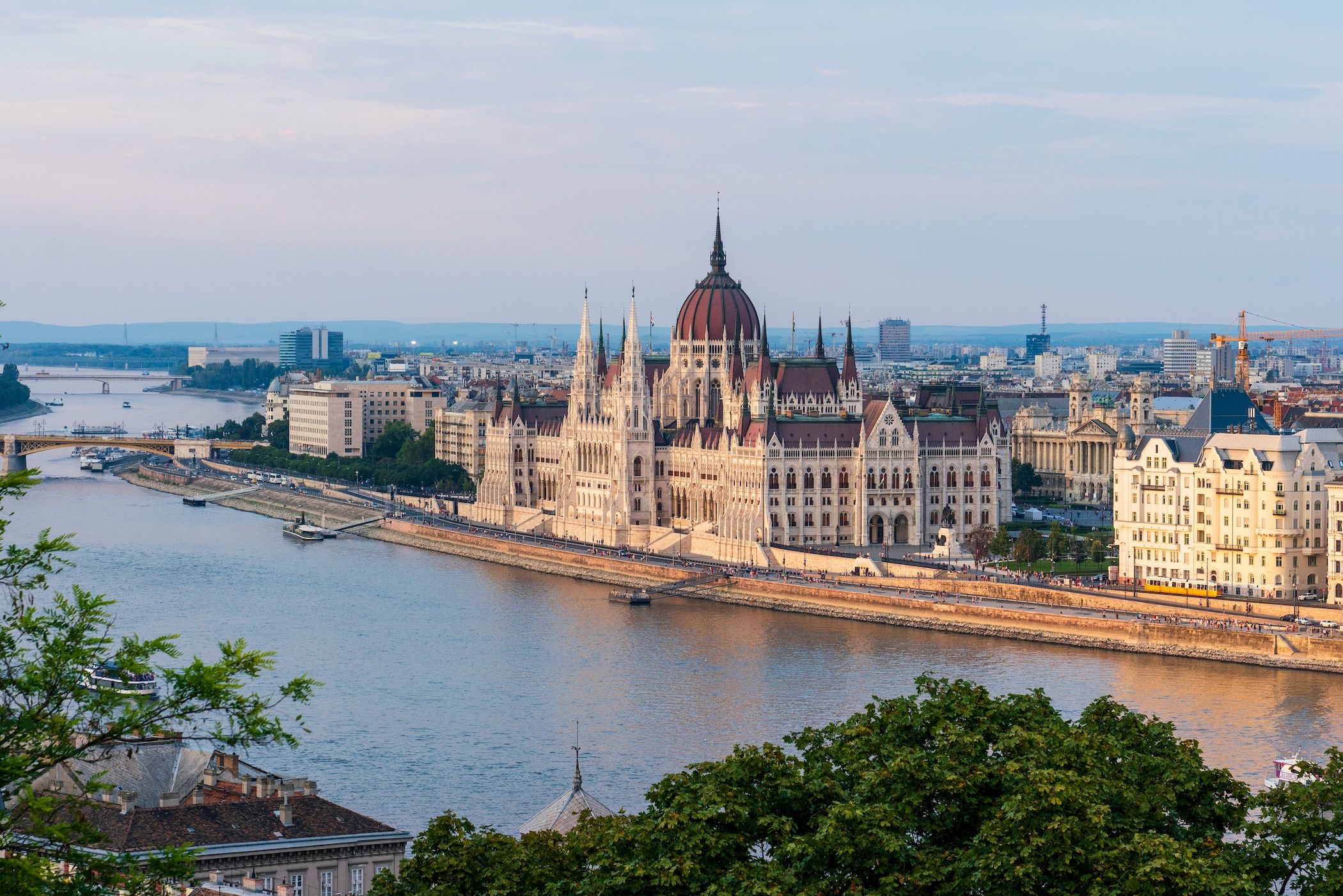
Budapest is the capital of Hungary and is most often referred to as the Paris of the East. The city is split in half by the Danube River, with the left side named Buda and the Right side named Pest. Beautiful buildings and parks line the Danube River, and there is plenty to do, eat, and explore!
The Best Time to Visit Budapest
The best time to visit Budapest is in early fall (Sept-Oct) or late spring (Apr-May). These are shoulder seasons in Budapest with ideal weather.
- MAR-MAY: Spring is one of the best times to visit Budapest. The weather is pleasant, you’ll see lots of spring growth, and there are a few festivals you can attend. Noteworthy festivals include the Gourmet Festival, Rosalia Festival, and Budapest Beer Week.
- JUN-AUG: Summer is peak tourist season in Budapest. It’s the hottest and busiest season of the year, so it may not be the best time to visit. Plus, hotel room rates will be at their highest!
- SEPT-NOV: Like spring, autumn is the best time to visit Budapest. The summer heat and crowds have dissipated, and visitors will be treated to fall colors and a host of festivals. The Budapest Wine Festival and Jewish Cultural Festival take place in September, while October is highlighted by Oktoberfest.
- DEC-FEB: Budapest experiences cold winters. Snowfall is common, so it’s one of the most picturesque times of the year to go to Budapest, if you can tolerate cold weather. Christmas is peak season in Budapest, so expect thicker crowds and higher hotel prices. Budapest also hosts a Christmas Market.
How to Get to Budapest
- By Plane: There are many flights that go to Budapest from different cities in Europe. You can do a search on a flight aggregator like Skyscanner to find cheap flights to Budapest Ferenc Liszt International Airport (BUD).
Budapest Airport is located about 16 km southeast of the city center. You can make your way to downtown Budapest in one of the following ways.
- Bus: This is what I did. It’s the cheapest way to get into downtown Budapest from the airport. The 100E bus costs HUF 900 and will take you directly into Budapest (Kalvin ter, Astoria, and Deak ter) in 30-45 mins. It runs every 20 mins, with the last bus leaving the airport at 1:20 AM. Before exiting the arrival terminal, there’s a booth on the far left side where you can purchase tickets to the 100E bus. I believe there’s a ticket dispenser next to the bus stop as well. You’ll need to purchase your ticket before boarding the bus.
- Shuttle: If you’re looking for a convenient but cost-effective way of getting to your hotel from the airport, then the miniBUD shared shuttle service is perhaps the best option. It’ll take you directly to your hotel. However, since this miniBUD shuttle is a shared service, then it may take longer than the 100E bus depending on how many stops it needs to make. If that isn’t a problem, then you can book tickets in advance through the miniBUD website or Get Your Guide. I believe the cost varies depending on how many people you have in your group, so be sure to check both sites to find the better deal.
- Flibco Shuttle Bus: Another option is to go by flibco shuttle bus. It’ll take you from Budapest Airport to designated spots in the downtown area. You can book flibco shuttle bus tickets on Bookaway.
- Private Transfer: This is more expensive, but it’s the most convenient way of getting from the airport to your hotel in downtown Budapest. You can book a private transfer through Get Your Guide.
- Taxi: Taxis should cost about the same as private transfers, perhaps a little less. You can use Uber Taxi or Bolt Taxi to get around.
Other Ways to Get to Budapest
- By Train: Budapest has three international railway stations and is well-connected by train to many central European cities. We didn’t take a train to go to Budapest, but we did take one from Budapest to Prague. You can search for train routes to Budapest on Trainline.
- By Bus: Traveling by bus is one of the cheapest ways to get into Budapest. We highly recommend Flix Bus.
- By Car: Traveling by car is a great way to explore Budapest and many parts of Europe. It gives you the freedom to stop wherever you want, whenever you want. Parking is a bit hectic, but you’ll get the most freedom. If you’re looking to rent a car and drive to Budapest, then you can rent one on Rentalcars.
Where to Stay in Budapest
Budapest is separated into districts:
- District I (Varkerulet)
- District V (Belvaros)
- District VI (Terezvaros)
- District VII (Erzsebetvaros)
- District VIII (Jozsefvaros)
We recommend District VII and VIII as they are close to many attractions.
Budapest has a good network of trams, buses, and subways. They’re all affordable, but be sure you always validate your ticket because they do check tickets often (you don’t want to get fined — which is $30-$60).
Download the SmartCity Public Transportation app for your smartphone as it gives you offline maps/routes for all the public trans in Budapest.
Single Ticket: 350 HUF ($1.30)
Book of 10 Single Tickets: 3,000 HUF ($11)
Unlimited Day Pass: 1,650 HUF ($6.15)
Train Ticket Between Airport and City: 400 HUF ($1.50)
OTHER RANDOM PRACTICAL TRAVEL TIPS
- Take a ride on Tram #2 for a ride with amazing views along the Danube and a number of Budapest’s major sights. In fact, taking any tram around the city is a nice way to see the city.
- Head to the river at night to get beautiful views of the city lights.
- Keleti Train Station is fairly sketchy and is a popular spot for pickpockets and crooked taxi drivers. I don’t recommend hanging around there any longer than needed.
MORE RESOURCES TO HELP YOU PLAN YOUR VISIT ON A BUDGET
I’m still a fan of ol’ fashion guidebooks as it gives you a quick and easy way to research your destination. If nothing else, head to the library or bookstore and spend an hour or so thumbing through a guidebook — it’s worth it. We’ve also listed a few websites/blogs that will help with your planning.
Best Things to Do in Budapest
There is so much to do in Budapest, but it’s so worth visiting! Here is our list of things we highly recommend prioritizing.
- Stroll Along the Danube River: The banks of the Danube River are listed as a UNESCO World Heritage Site so you should spend some time visiting the Danube Promenade. It’s also a great place to see many of Budapest’s best sights.
- St. Stephen’s Basilica: Not only is Saint Stephen’s Basilica the largest church in Budapest but it also contains St. Stephen’s mummified right hand. Possibly more impressive are the views from the top of the church as it also offers the highest 360-degree views of the city. Cost is 12 euros.
- Castle Hill or Quarter: Perched above the city, Castle Hill is a must-visit neighborhood of Budapest. Some of the buildings date back to the 14th and 15th centuries. Set aside a day to discover its winding cobblestone streets. The area also contains many of Budapest’s top attractions like Trinity Square, Matthias Church (Mátyás templom), Fisherman’s Bastion (Halászbástya), and Buda Castle. The Castle Quarter or Varnegyed, is one of the main tourist areas in Budapest.
- Visit all 8 Bridges
- Great Market Hall: Built in 1894, this massive indoor market draws a major crowd looking for fruits, vegetables, prepared foods, and random souvenirs. It is a bit of a tourist trap as the prices are a lot higher than what you’d find over on the Buda side of the city. However, it’s a nice place to go for small bites and to look at the architecture of the hall.
- Vajdahunyad Castle
- Hungarian Parliament: This iconic building is the largest building in Hungary and it’s the third largest parliament in the world. It’s a treat to admire from the outside but you can also admire the inside by taking one of the daily tours (in English) for around $14. Nearby is a monument called Shoes on the Danube that was created to honor Jews who were killed during WWII.
- Memento Park: The communists loved building statues and monuments so Budapest was full of them during their years behind the Iron Curtain. Once communism in Budapest ended the people tore down almost all these statues and put them in a park in the outskirts of town. Now it’s a fun place to go visit and get selfies with Stalin. It’s a bit of a pain to reach via public transport so a tour might be easier. Visit Website.
- Heroe’s Square & City Park: City Park is where people of Budapest go to escape the city (it’s also where you’ll find the Széchenyi Baths). In this 302-acre park, you’ll also find a zoo and a replica Transylvanian Vajdahunyad Castle. It’s a fun place to explore on a nice day.
- Hungarian State Opera House: This neo-Renaissance opera house is one of the finest in the world. Better yet, you can actually score some cheap tickets to see an opera if you’re into that. If nothing else, you can also take a tour of the inside. View Website.
- ANDRÁSSY ÚT (ANDRÁSSY AVENUE): This grand tree-lined boulevard runs through Budapest is a UNESCO Heritage Site and is best explored on foot. It connects the Opera House and City Park, and is the location of the city’s most expensive real estate.
- Esceri Flea Market: This is one of the biggest flea markets in Central Europe, and it sells just about everything you can imagine. It’s a good place to pick up a unique souvenir. It is located about 40 minutes outside the city, but it is easily reached via public transportation.
- Explore a Thermal Bath: Budapest is known for its natural thermal baths — in fact, even the Romans enjoyed the city’s thermal baths. Some say the thermal springs which fill these baths have healing powers. I have no idea if there is any scientific evidence to back up their claims, but I do know that they sure are relaxing — which is why you’ll find people of all ages enjoying these warm waters. Budapest has a handful of different thermal bathhouses — some are barebones and others are quite opulent. Most all have multiple small pools, each with different temperature water (some can be quite hot, so be careful). The two most famous thermal baths are SZÉCHENYI SPA are GELLÉRT SPA. (temporarily closed) Széchenyi, built in 1913, is probably the most popular, and it’s a beautiful neo-baroque bath complex that consists of 11 medicinal pools and eight swimming pools. It’s also one of the largest spas in Europe. A ticket (including a cabin or locker) will cost around $15-$20. Gellért is another popular option. Built in 1918, this opulent thermal bath complex features four thermal-medicinal pools, six other indoor pools, and two outdoor pools. Expect to pay around $20 for entrance and a cabin or locker rental. The best source for more information about Budapest’s baths is BathsBudapest.com — here you’ll find locations, hours, prices, and other helpful information.
- Ervin Szabo Library
- Budapest Cave Church
- Ride the Oldest Train Line in Budapest: M1 and the third oldest in the world!
- Ride a Ferry to Cross the Danube River: Pictured below is Boraros ter H (Petofi hid) ferry terminal. We took the D12 ferry from here and got off at Kossuth Lajos ter M to visit the Hungarian Parliament building.
- BKK Boat (Ferry): Single boat tickets cost HUF 750 each. It may not be the most efficient means of transport, but it’s a great way of experiencing the Danube without paying for a river cruise (about 16 euros and 50 minutes long).
- Great Synagogue: The Great Synagogue is not only a beautiful structure, but it’s also the world’s second-largest synagogue. Visit Website. The Dohany Street Synagogue is the biggest in Europe. It was built in 1859 and contains a mixture of Byzantine, Gothic, and Romantic architectural styles. Aside from the synagogue itself, inside the complex is the Heroes’ Temple, the Jewish Museum, a graveyard, and a memorial site. You can pay for admission at the gate or book a guided tour that stops at the Great Synagogue. In our case, we took the scenic Tram 2, which runs along the Pest waterfront to Boraros ter H (Petofi hid) ferry terminal. From there, we took a ferry to Kossuth Lajos ter M to visit the Hungarian Parliament building. While sitting on tram #2, you can admire the sights of the Pest embankment in about 20 minutes. You will also pass by some famous locations like the Parliament, Roosevelt tér, and Vigadó tér.
- Go on a scavenger hunt for Mihál Kolodko mini statues! There are over 50 miniature statues created by local artist Zolodko scattered around Budapest. I created a map of the Kolodko mini statues to help you find them.
View this post on Instagram
Where to Eat in Budapest
Vendéglő-s and önkiszolgáló-s (self-service restaurants) are the best cheap restaurants in Budapest. These places have unpretentious interiors, usually with plastic or checkered textile tablecloths.
Things to Try
- Gulyásleves – Goulash is a meat stew with vegetables and served with bread.
- Pörkölt – Meat stew in a paprika sauce.
- Kolbice – Grilled Kolbász sausages in a wheat-bread cone.
- Langos – Fried flatbreads topped with sour cream and cheese. They also offer these “Hungarian pizzas” with other toppings.
- Lecsó – Vegetable stew
- Paprikás Csirke – Creamy chicken paprikash with paprika and a chicken leg.
- Marhapörkölt – Beef and onion stew often served with rice.
- Kürtőskalács – Hollowed-out cinnamon roll known as a spit pastry or chimney cake.
- Túró Rudi – Chocolate-covered cottage cheese stick. Sold in most convenience and grocery stores.
Where to Drink in Budapest
Budapest is most famous for its Ruin Pubs, which are pubs built in abandoned buildings. After WWII, many of Budapest’s buildings in the Jewish neighborhood were destroyed. Years later, people moved into (i.e. squatted in) these buildings and turned them into secret underground pubs and bars. Many of these bars still exist, and they each have their own vibe. The three main ruin pubs are Szimpla Kert, Instant, and Fogas Ház.
Check out RuinPubs.com for the most up-to-date information on Budapest’s ruin pubs.
Tokaji or Tokay refers to wines grown in the Tokaj region of Hungary. The region is known for producing sweet dessert wines affected by noble rot, which is a type of mold (Botrytis cinerea) that develops on the grapes. When the mold dries out under the sun, it concentrates the grape’s sugars, giving the wine its distinct flavor.
Like Portugal’s Port wine, Tokaji has been given Protected Designation of Origin (PDO) status. For wine to carry the Tokaji name, it needs to be produced in the Tokaj region using specific varieties of grape.
There are many wine bars where you can try Tokaji in Budapest, two of the most recommended being Kadarka and Veritas. Both are located in District VII.
Budapest Travel Guide Map
Ready to explore Budapest? Save this post and use our Budapest Travel Guide map to get around town.
If you found our Budapest travel guide helpful, please share this post. Thanks for your support!
Thank you for visiting today! If you found this encouraging or informative, please connect with us on Instagram or TikTok. Sign up for our monthly newsletter for updates and more. We promise we won't spam you! Feel free to unsubscribe anytime. If you're a brand and want to work with us, please visit this page to get in touch.